
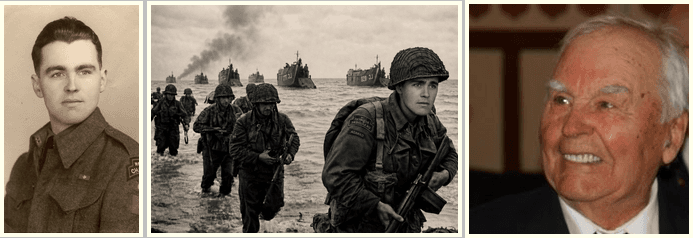
Réal left his family in 1941 to join England. He trained there until the evening of June 5, 1944, the eve of D-Day. He landed at 7:00 in the morning on June 6, and finished in Berlin in 1945. Réal was my friend and I called him my hero until 2018, the date on which he departed for good...
Here is the testimony of Réal Boulet.
''I collapsed from exhaustion, I fell asleep. They left me for dead. I was on the other side of the road when I woke up and they were gone. I was the oldest in a family of 15 children, so I told myself they would still lose a guy in the family. My mother, when she was young, had worked at Victoria Hospital in Quebec City. It was during the other war. She knew all the songs against the Germans, so we had learned them ourselves. One day, I ran into one of my buddies in Saint-Paul-de-Montmagny, (Quebec) and he said to me: shall we enlist? We had seen it at the post office, a poster that said enlist in the regiment. My salary at the time was 40 dollars a month at the creamery. Those weren't big wages in the Depression years, still 1939-1940.
In Normandy, it was on June 6 that I took part in the Landing. There was a five-foot cement wall with three inches of barbed wire on top. And then there were regimental engineers who had tubes filled with dynamite. They blew those up so we could get through. We managed to get through. We passed beside the church. We had quite a large hill to climb. That was our objective for the day. We had to get there. We climbed it while fighting all the way. We covered five, six miles. We rounded up some Germans, about 45. We surrounded them. By evening, they positioned the companies on each side of the road with shovels, our shovels for shovelling gravel that we had in our baggage. We had started digging a small trench when the German tanks launched a counterattack. There was a man named Roy, from the regiment. He had come up with a Jeep carrying a small cannon. He had managed to knock out about fifteen German tanks that were coming at us. He caught them and was still aiming to take out more. He killed the German general who was leading that attack.
We didn't see everything that was happening. They took a few prisoners from [the Régiment de] la Chaudière. They turned around pretty quickly, when the Germans saw that with very little they had already lost about fifteen tanks. They turned around and went to hide in the bocage. The next day, Canadian and British fighter planes arrived and they took care of that bunch for us.
We were supposed to go and attack the large city of Caen. The general [Field Marshal Erwin Rommel] who was in charge of that entire German army, he had his work cut out too. Then we moved in and covered seven, eight miles, and we came back around behind Caen. We took the airport. We had managed to take the airport but as for the city of Caen, they decided they had no choice but to kill all the Germans in the city. I remember it was evening and all of a sudden seven or eight hundred bomber planes arrived. They dropped everything on the city of Caen. A huge cloud of dust. The city was annihilated. Only one church was left standing. After about a week, we passed through the city of Caen and it smelled bad. There had been 60,000 French people there [before the Battle of Normandy]. The SS [Schutzstaffel] went through them. That's war.
A rest — I'll be honest with you, it happened at Carpiquet, two or three days before. I collapsed from exhaustion, I fell asleep. They left me for dead. I was on the other side of the road when I woke up and they were gone. I rejoined them. It was the taking of Carpiquet. It had already been three weeks. When we took Carpiquet, the newspapers talked about how hard it had been to take — the Germans were organized and ready to receive us.
The French were happy. In Normandy, I passed about 50 miles from the lands of my Norman ancestors, the Boulets. The waterfalls were almost original. We sang the song, "J'irai revoir ma Normandie!" We didn't always have time to talk with them. We were drilled [trained]; we had to march from one place to another. When we were by the side of the road, we'd collapse there and sleep. There were still many German soldiers but they knew the war was over. We still had to stay armed to keep things under control. The regiment stayed in northern Germany for the occupation. And as for me, since I had been in the army for five years, they sent me to Canada to see my parents.
When I arrived, my sisters — I barely recognized them anymore. They had grown up in five years. There were fifteen of us at home. They came to pick me up at the Quebec City train station. It's a strange feeling to see your parents again. My parents weren't rich, they had woodlots but they weren't rich. With 15 children, I was sending them half my salary. My 40 dollars. I had to help them. I was the oldest. That rest was quiet; I would sometimes cry my eyes out — it was the nerves settling back down. After that, I went back to working as a lumberjack.
Peace, peace, pray that it comes. We go to the rosary every day for peace, so that it never happens again.''
Philippe Goupil
So let us never forget Réal and all those men who went to take part in the liberation of Europe.