
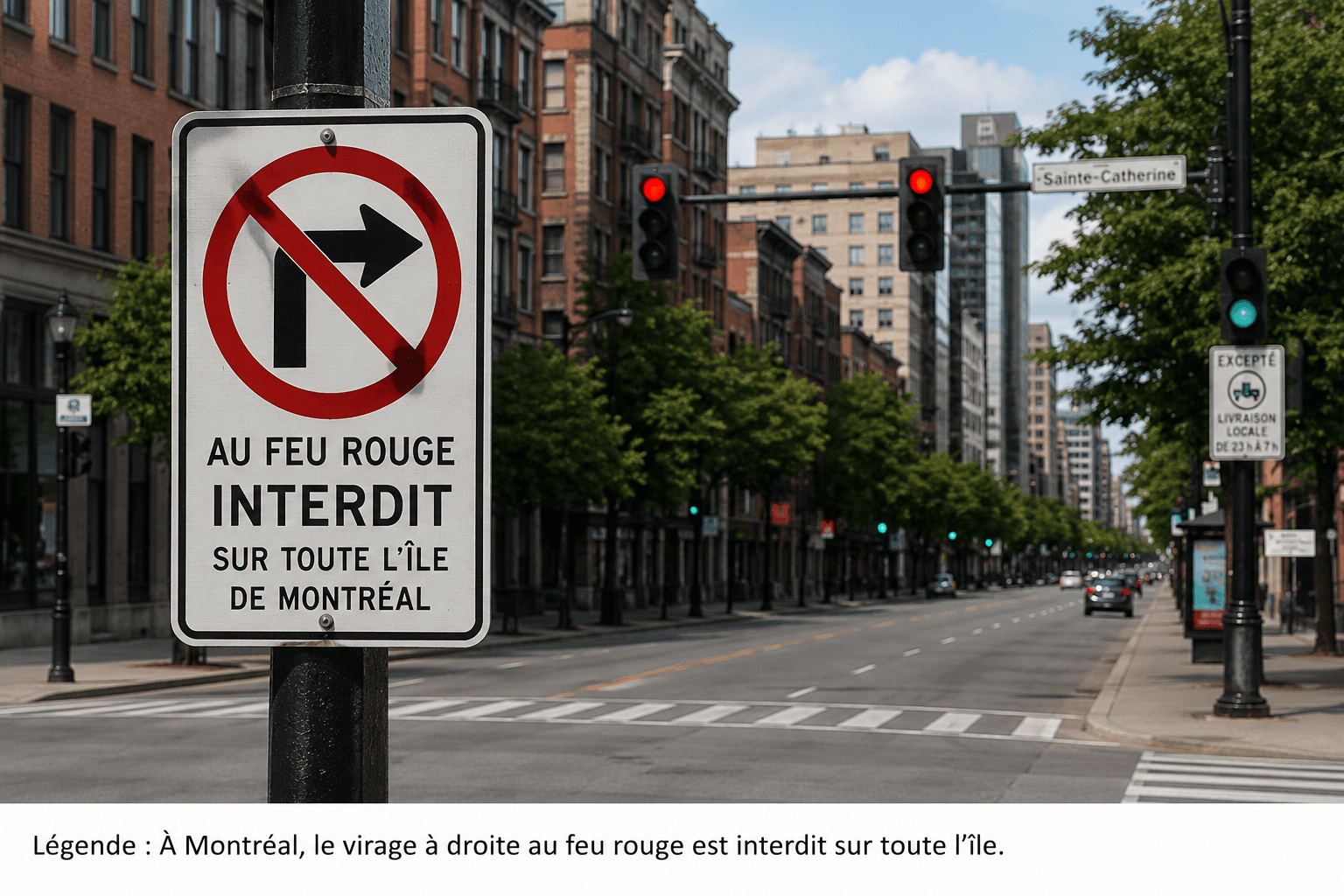
This practical guide introduces European and international visitors to the essential rules of driving in Quebec, with an emphasis on North American specificities such as right turns on red lights (prohibited in Montreal), four-way stops, school buses, and winter driving. Written in a warm and reassuring tone, it also covers licensing, speed limits, car rentals, rural roads, and the right reflexes to adopt in order to explore the province with complete peace of mind.
Driving in Québec: The Rules of the Road You Need to Know Before You Go
A practical guide to discovering La Belle Province with complete peace of mind
Welcome to Québec's Roads
Québec is a vast territory that lends itself wonderfully to exploration by car. From the grand boulevards of Montréal to the villages along the St. Lawrence River, from the scenic roads of Charlevoix to the deep forests of Mauricie, the province reveals itself fully to those who get behind the wheel.
Hitting the road here means savouring that quintessential North American freedom: landscapes rolling by, spontaneous stops in a countryside village, a coffee by the lake, an impromptu hike in the Laurentians.
Before you set off, a few Québec-specific rules are worth knowing. Some differ from what you may be used to in Europe. Nothing complicated, but it's better to be prepared so you can make the most of your trip.
1. Your Driver's Licence in Québec
Good news for European visitors: your national driver's licence generally allows you to drive in Québec for a tourist stay of up to six months.
An international driving permit is not required for visitors whose licence is written in French or English. It is nonetheless recommended if your licence is issued in another language or alphabet. It does not replace your national licence — both documents must travel together.
Documents to always have with you in the car:
- Your driver's licence (and international permit if applicable)
- Your passport
- The vehicle rental agreement
- Proof of insurance provided by the rental company
In the event of a police check, you will need to present these documents. Stay calm, be polite, and wait for the officer's instructions before reaching for your papers.
2. The Basic Rules of Driving in Québec
In Québec, as in the rest of North America, driving is on the right and overtaking is on the left. Signage is clear, generally bilingual or in French, and the road infrastructure is well maintained.
A few basic principles to keep in mind:
- Traffic lights are often suspended above intersections, which can come as a surprise at first.
- Signage makes frequent use of written message signs (ARRÊT, CÉDEZ, etc.) rather than pictograms.
- Distances and speeds are shown in kilometres.
- Fuel volumes are in litres.
In urban areas, watch out for the many pedestrians, cyclists and delivery vehicles. In rural regions, driving is more relaxed, but you should still remain vigilant for wildlife and long distances.
3. Speed Limits
Speed limits in Québec are posted in kilometres per hour (km/h). Here are the standard references:
| Road type | Common limit |
|---|---|
| Highways | 100 km/h |
| Regional and rural roads | 70 to 90 km/h |
| Towns and villages | 50 km/h |
| Residential zones | 30 to 40 km/h |
| School zones | 30 km/h (during posted hours) |
| Construction zones | Reduced (often 70 km/h or less) |
School zones are particularly closely monitored, with fines doubled during school hours. Construction zones are too: slow down systematically as soon as you see an orange sign.
Speeding is monitored by police officers, but also by fixed and mobile photo radar, which is often signalled in advance.
4. Right Turn on Red
Here is one of the rules that confuses European visitors the most: in Québec, you are permitted to turn right on a red light, after coming to a complete stop and yielding to pedestrians and vehicles that have the right of way.
However, this rule only applies:
- ✅ Throughout Québec, unless otherwise indicated by a sign ("No right turn on red")
- ❌ Nowhere on the Island of Montréal, where turning right on a red light is entirely prohibited
This is an important distinction: as soon as you leave the Island of Montréal (by crossing a bridge, for example), the rule changes. Always rely on local signage.
In practice:
- You arrive at a red light and wish to turn right.
- You come to a complete stop, as you would at a stop sign.
- You check that no pedestrian is crossing and that no vehicle is approaching.
- You turn.
If in doubt, remain stationary until the light turns green. That is always permitted.
5. ARRÊT Signs
The ARRÊT sign (the Québec equivalent of the European STOP sign, written in French) is ubiquitous in Québec, especially at intersections in residential neighbourhoods and villages.
The stop must be complete. Simply slowing down is not sufficient, even if the street appears empty: police officers watch for this, and the fines are steep.
The Special Case of Four-Way Stop Intersections
At many intersections, all vehicles must stop, in all four directions. This is the "first to arrive, first to go" rule.
A simple example:
You arrive at the intersection and are the first to stop. You go first. If two vehicles arrive at the same time, the vehicle to your right has the right of way. Eye contact and a small wave of the hand are often enough to resolve the situation courteously.
This becomes second nature very quickly. Québecers are generally patient and polite at these intersections.
6. Yellow School Buses: A Sacred Rule
The large yellow school buses are part of the Québec landscape. When they stop to pick up or drop off children, they extend a red stop arm and activate flashing red lights at the front and rear.
In this case, you must stop immediately, regardless of your direction of travel. This rule applies to:
- Vehicles following the bus
- Vehicles travelling in the opposite direction
The exception: if you are travelling on a roadway divided by a median strip (highway, divided boulevard), vehicles travelling in the opposite direction are not required to stop.
You may not proceed until the lights have stopped flashing and the stop arm has been retracted. Violations are severely punished: children's safety is at stake.
7. Sharing the Road with Pedestrians and Cyclists
In Québec, pedestrians have the right of way at crosswalks, and many streets are shared with cyclists, particularly in Montréal and Québec City.
Good habits to adopt:
- Slow down when approaching any crosswalk, even without a traffic light.
- Check your mirrors carefully before opening a door: "dooring" (hitting a cyclist with your door) is an offence.
- Yield to cyclists crossing an intersection or using a bike path.
- Exercise particular patience in Old Québec, Old Montréal, Tadoussac, Percé and any other heavily touristic area where pedestrians can appear at any moment.
Road courtesy is highly valued in Québec. A small wave of the hand to say thank you or to yield is always appreciated.
8. Alcohol, Cannabis and Mobile Phones: Zero Tolerance
Québec enforces very strict rules regarding impaired driving.
Alcohol
The legal blood alcohol limit is 80 mg of alcohol per 100 ml of blood (0.08). However, from as low as 50 mg (0.05), your licence can be suspended on the spot.
For new drivers (probationary licence) and those under 22, the rule is zero alcohol while driving.
Our advice is simple: if you drink, you do not drive. Take a taxi, an Uber, or designate a sober driver.
Cannabis and Drugs
Cannabis is legal in Québec, but consuming it before or while driving is strictly prohibited, as is any other substance that impairs your abilities.
Mobile Phone
Using a hand-held mobile phone while driving is completely prohibited, even when stopped at a red light. Only hands-free mode (Bluetooth, fixed mount) is permitted.
Fines start at several hundred dollars, with demerit points added to your record.
9. Seatbelts and Children
Seatbelts are mandatory for all vehicle occupants, both front and rear. This rule allows for no exceptions, even for a trip of just a few minutes.
Child Passengers
Children must travel in a car seat appropriate for their age, height and weight:
- Infant car seat for babies
- Child seat with harness
- Booster seat until the child is at least 145 cm tall or reaches the age of 9
Most rental companies offer child seat rentals. Book one in advance to avoid any surprises.
10. Driving in Québec in Winter
A Québec winter is beautiful… and demanding. If you are travelling from December to March, these tips are essential.
Winter Tires: Mandatory
From December 1 to March 15, winter tires are mandatory on all vehicles registered in Québec. Rental vehicles provided during this period are equipped with them as standard. However, check with the rental company, especially at the beginning or end of the season.
Snow, Ice and Visibility
- Braking distances are much longer on snowy or icy roads.
- Drive smoothly: brake gradually, accelerate gently, take wide turns.
- Increase the following distance between you and the vehicle ahead.
- Drive with your headlights on in snow or low visibility conditions.
Clearing Snow from Your Vehicle
Before setting off, remove all snow and ice from the roof, hood, windows, headlights and mirrors. Snow flying off the roof can cause accidents and earn you a fine.
In the Regions: Extra Caution
In Charlevoix, Gaspésie, the Laurentians, Saguenay–Lac-Saint-Jean, Côte-Nord and Abitibi, conditions can change very rapidly. Always check the weather and road conditions before heading out (the Québec 511 service is your best friend).
11. Parking: Read the Signs Carefully
Parking in Québec is regulated by signage that can sometimes be complex, especially in Montréal and Québec City. Take the time to read the signs carefully before leaving your vehicle.
Things to watch for:
- Time restrictions on parking (often linked to street cleaning)
- Snow removal days in winter (indicated by orange signs with a pictogram)
- Resident-only zones (permit required)
- Parking meters (often replaced by centralised payment terminals or mobile apps)
- Overnight parking bans on certain streets
In the event of a snowstorm, the city may declare a "snow removal operation": improperly parked vehicles will be towed. Check with your accommodation for details.
Outside of major cities, parking is simpler and often free.
12. Renting a Car: Points to Check
Renting a vehicle in Québec is straightforward, but a few precautions are worth taking.
Things to check at the time of booking:
- Mileage included (unlimited or capped)
- Insurance options: civil liability, collision (CDW), theft, third-party damage
- The deductible (amount payable by you in the event of a claim)
- Additional fees: additional driver, young driver, one-way return, GPS, child seat
- Winter tires if you are travelling between November and April
- Coverage for windshield and tire damage (often optional)
Tip: your premium credit card (Visa Gold, Mastercard World Elite, American Express) sometimes includes collision insurance for rentals. Check the terms before you leave — it can represent significant savings.
Always carry out a detailed inspection of the vehicle at pick-up, with photos to back it up. Note even the smallest scratch on the contract.
13. On Regional Roads: Preparing for Adventure
Québec is enormous. Outside the major cities, distances can come as a surprise, and some regions require particular preparation.
What to expect:
- Long distances between communities (sometimes 100 to 200 km between two service stations)
- Gravel forest roads in certain areas, particularly in Abitibi, on the Côte-Nord or in the Far North
- Wildlife on the road: moose, deer, bears, especially at dawn and dusk
- Limited or no mobile coverage in certain areas
- Little or no lighting at night
Our advice:
- Always fill up the tank before heading into a remote area.
- Bring water, snacks and a first aid kit.
- Let someone know your itinerary.
- If you encounter a moose, brake without swerving sharply: these animals weigh hundreds of kilograms.
14. Our Practical Tips for a Successful Stay
Before we wrap up, here are some tips we share with every traveller discovering Québec by car.
✔️ Be generous when estimating distances. On a map, two points may look close, but the drive from Montréal to Gaspé, for example, is nearly 10 hours.
✔️ Fill up before heading into remote areas. A service station may be closed in the evening, on Sundays or out of season.
✔️ Check the weather and road conditions. The Québec 511 service (website, mobile app, phone line) provides real-time information.
✔️ Keep an emergency kit in winter. Blanket, flashlight, shovel, sand or cat litter, energy bars, phone charger.
✔️ Respect speed limits scrupulously. Photo radar devices are numerous and discreet.
✔️ Don't rely solely on GPS. In remote areas, it can send you down an impassable forest road. Bring a paper road map.
✔️ Take your time on scenic routes. Route 132 in Gaspésie, Route 138 on the Côte-Nord, Route 362 in Charlevoix, the Route des Sommets in the Eastern Townships… these routes are meant to be savoured slowly.
✔️ Be courteous. A small wave of the hand, a turn signal used, a gap given: driving in Québec is relaxed and polite.
15. Hit the Road with Confidence
Driving in Québec gives your trip an unforgettable dimension. It means stopping in a village to try a homemade poutine, turning onto a country road because you spotted a "pick your own" sign, pulling over by the river in Kamouraska to watch the sunset.
Québec's rules are, on the whole, simple and logical. A few particularities — the right turn on red, school buses, four-way stops, winter tires — deserve your attention, but nothing that should take away from the pleasure of driving.
Take your time. Drive carefully. Smile at other drivers. And above all: stop often to take photos, chat, taste, breathe.
Québec is a place best discovered kilometre by kilometre. Safe travels!
📎 Appendix: Useful Resources
- Québec 511 – Road conditions and weather: quebec511.info
- SAAQ – Société de l'assurance automobile du Québec (official rules)
- Sûreté du Québec – Provincial police: dial 310-4141 (or *4141 from a mobile phone)
- Emergency: 911
This guide is provided for informational purposes by the team at J'aime le Québec. Rules may change: consult official sources for the most up-to-date information.